
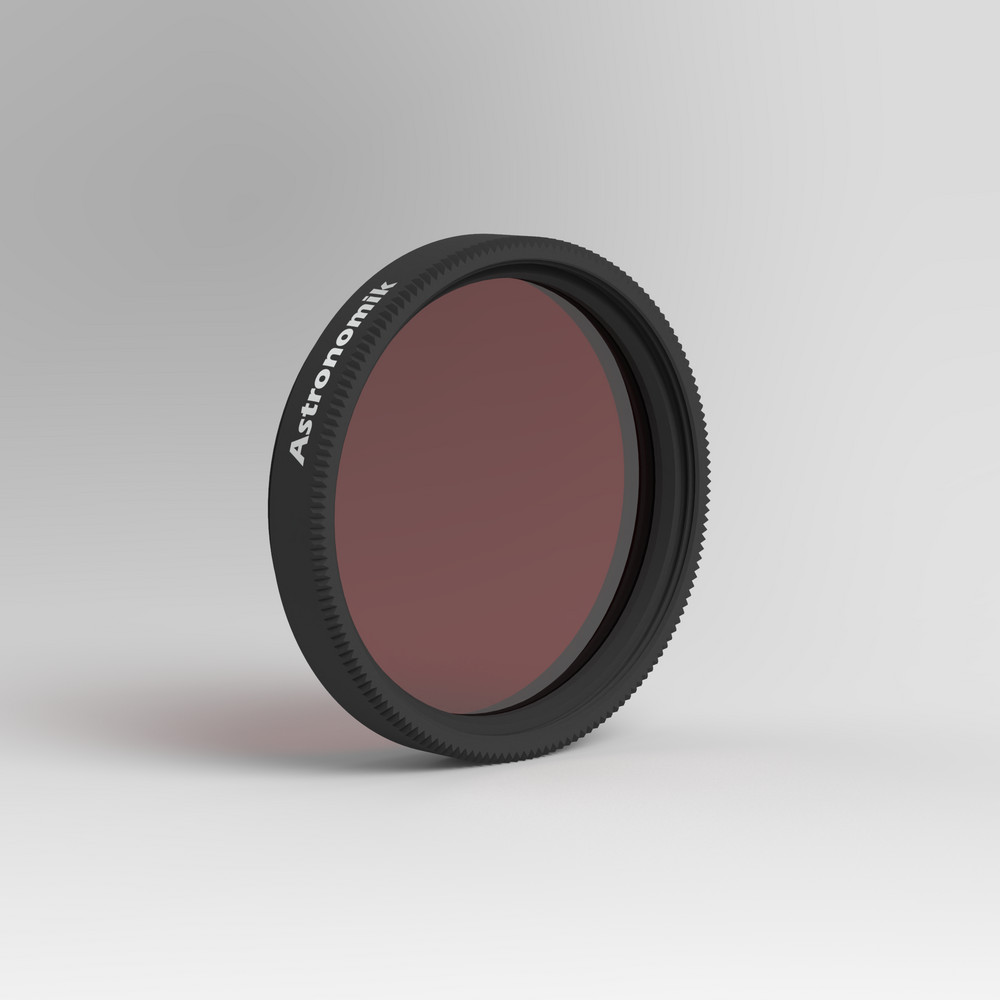
Astronomik H-alpha Filters
The Astronomik H-alpha filter is ideal for imaging HII regions from both light-polluted and dark observation sites.
The Astronomik H-alpha filter significantly enhances the contrast between objects emitting light at 656nm (H-alpha line) and the sky background, allowing for long exposure times for deep and high-contrast images.
The filter blocks the emission lines of high- and low-pressure sodium (Na)- and mercury (Hg)-vapor lamps, the maxima of typical LED lights, most lines of natural airglow, as well as most of the distracting moonlight.
The Astronomik H-alpha filter effectively blocks all unwanted light from wavelengths other than 656nm, from ultraviolet (UV) to infrared (IR).
The Astronomik H-alpha filter MUST NOT BE USED for solar observation!
Difference between Astronomik 12nm, 6nm and 4nm filters
The choice between 12nm, 6nm and 4nm Full-Width-Half-Maximum (FWHM) filters depends on your imaging conditions and camera type. There is no universal “best” option – each FWHM serves a specific purpose.
The 12nm Astronomik Narrowband-Emissionline filters are optimized for use with system cameras with CMOS sensors. They are also a good choice for CCD cameras with normal or high dark current. The 12nm filters are also the preferred choice for cameras with an integrated or dual guiding sensor, as they show more guiding stars compared to filters with 6nm or 4nm FWHM.
The 12nm filters are the most affordable way to get started with Narrowband-Emissionline filters. Usually, the background signal in images taken from suburban or dark-sky locations is limited by the sensor’s dark current rather than light pollution. Therefore, further suppression of the sky background by reducing the FWHM does not reveal more details of the object.
The Astronomik MFR coating
Both the Astronomik MFR and MaxFR coatings offer extremely high contrast, minimized stray light, no halos and needle-sharp stars. In addition, they provide the best possible blocking across the entire spectral range from UV to IR.
Size of filter
Astronomik filters come in a wide range of standard sizes, both mounted and unmounted, to suit various optical setups and cameras.
Technical Data
• Guaranteed transmission of more than 90% at the H-alpha line (656nm)
• Typical transmission of 96% at the H-alpha line
• Full-Width-Half Maximum (FWHM): 12nm
• Glass thickness: 1mm (except Astronomik OWB Type 3 and XT filters)
• Finely polished optical glass, free of any striae, residual stresses, and bubbles
• Extremely scratch-resistant and durable coating
• Completely resistant against high humidity and aging effects
• Astronomik MFR coating (Astronomik Deep-Sky RGB, UV-IR Block L-1, L-2, L-3, and Narrowband-Emissionline filters)
• Parfocal with other Astronomik filters
• Diffraction-limited
• Optimized spectral windows
• Delivered in a high-quality, long-lasting filter box
• Made in Germany
Astronomik filters are diffraction-limited, ensuring that the optical performance (resolution and contrast) of your telescope is not compromised. Thanks to the high-precision machining of the glas substrate, all Astronomik filters are parfocal. The wedge errors are far below all common tolerances. Therefore, all issues concerning focal distances and the exact alignment of images from each color channel are effectively eliminated.
All Astronomik filters are ideal for modern cameras, including both CMOS- and CCD-based models, ensuring you capture the best possible images with your equipment. Sharpness, contrast, and the absence of any reflections and halos are guaranteed. Even with bright stars in the field of view, nebulae and galaxies will be captured with the finest structures. The Astronomik MFR and MaxFR coatings are designed for optimal performance across a wide range of focal ratios of the optics used.
Every Astronomik filter undergoes a rigorous quality control process before delivery. Additionally, each Astronomik Narrowband-Emissionline filter is measured using a high-end PerkinElmer Spectrophotometer to ensure it meets the specifications published on our website. On the back of each Narrowband-Emissionline filter box, you will find a label detailing the precise spectral data for that specific filter, including the maximum transmission and the recommended range of focal ratios for best performance of that specific filter.


Leave a Reply