
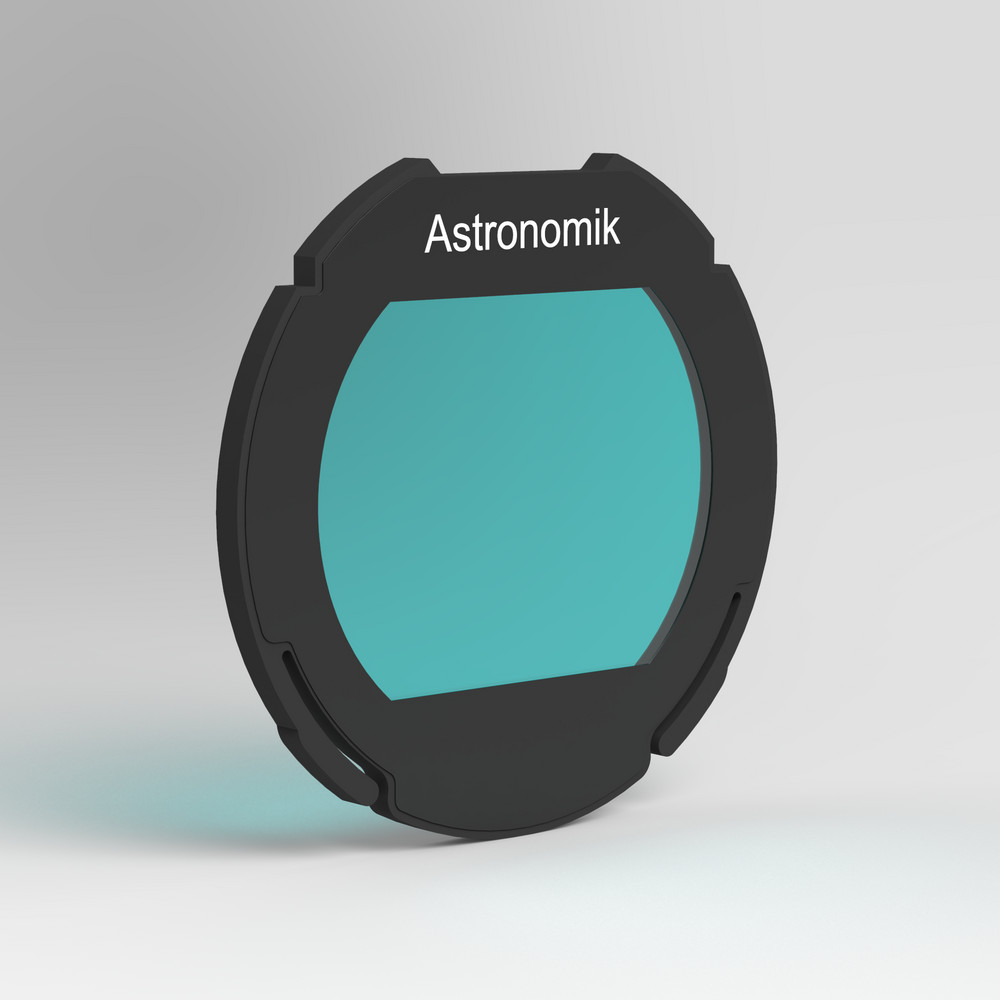
Astronomik CLS Clip-Filter
The Astronomik CLS filter is the best choice for astrophotography in light-polluted areas, regardless of whether the targets are galaxies, gas nebulae, star clusters, or comets.
Due to its wide passband, the Astronomik CLS filter allows a lot of light to reach the sensor, so that stars are only minimally dimmed. The filter is designed to block as much unwanted light as possible while still allowing for a nearly true-color reproduction of the objects.
The Astronomik CLS filter almost completely blocks the emission lines of high- and low-pressure vapor lamps (sodium (Na) and mercury (Hg) ), the emission maxima of LED lighting, as well as all lines of natural airglow. However, most of the light from stars and emission nebulae passes through. This significantly enhances the contrast between deep-sky objects and the background. Thanks to its design, the Astronomik CLS filter is ideal for capturing images of a wide range of objects, including galaxies, open and globular clusters, reflection and gas nebulae as well as comets.
With an Astronomik CLS filter, you can take beautiful astrophotographs even from light-polluted locations.
Other uses
The 1.25″- and 2″-cell models can be used for visual observations from light-polluted areas as well.
Alternatives
• If there is no built-in IR cut filter in your camera, a Astronomik CLS CCD filter is required.
• The Astronomik UHC filter is especially suitable for photography of emission nebulae with strong light pollution.
• The Astronomik UHC-E filter is better suited for photographing emission nebulae and comets with moderate light pollution.
Suitability of the Astronomik CLS filters
• CMOS and CCD photography: Good, requires an additional Astronomik IR-Block filter
• DSLR photography (original): Good, color balance is shifted, but contrast is enhanced
• DSLR photography (astro-modified): Very good, color balance is close to perfect
• DSLR photography (MC-modified): Good, requires an additional Astronomik IR-Block filter
Clip-Filter for Canon EOS APS-C DSLR cameras
Canon EOS DSLR cameras with APS-C sensors are an excellent choice for astrophotography. With Astronomik Clip-Filters, you can use our full range of filters with your camera to capture stunning images. Whether paired with a camera lens or a telescope, our Clip-Filters ensure maximum image quality and performance from your setup.
The Astronomik Clip-Filters offer a number of practical advantages that make them an ideal choice for astrophotographers:
• Installing and removing the Astronomik Clip-Filter is very quick and easy and requires no extra tools or modifications to the camera body. They can be changed at any time, even at night.
• All lens functions, such as focus, aperture, and image stabilization remain fully functional.
• The Astronomik Clip-Filters are held securely in place without stressing the high-quality glass.
• The Astronomik Clip-Filters are designed and optimized for use with both standard camera lenses and telescopes.
Through the Astronomik Clip-Filters, we were able to solve several common issues faced by astrophotographers:
• Large filters for large camera lenses are very expensive.
• Using a filter holder between the camera body and the lens prevents focusing to infinity.
• For very fast telescopes (low f-number) like the Vixen R200SS or the Takahashi “Epsilon” astrograph, a filter drawer or filter wheel can not be used because the distance to the corrector lenses would be changed.
• Long exposure times lead to dust settling on the camera’s sensor chip.
Technical Data
• 92% transmission at 486nm (H-beta)
• 92% transmission at 496nm (OIII)
• 92% transmission at 501nm (OIII)
• 97% transmission at 656nm (H-alpha)
• Transmission range: 450 to 540nm and above 650nm
• Glass thickness: 1mm (except Astronomik OWB Type 3 and XT filters)
• Finely polished optical glass, free of any striae, residual stresses, and bubbles
• Extremely scratch-resistant and durable coating
• Completely resistant against high humidity and aging effects
• Parfocal with other Astronomik filters
• Diffraction-limited
• Optimized spectral windows
• Delivered in a high-quality, long-lasting filter box
• Made in Germany
Astronomik filters are diffraction-limited, ensuring that the optical performance (resolution and contrast) of your telescope is not compromised. Thanks to the high-precision machining of the glas substrate, all Astronomik filters are parfocal. The wedge errors are far below all common tolerances. Therefore, all issues concerning focal distances and the exact alignment of images from each color channel are effectively eliminated.
All Astronomik filters are ideal for modern cameras, including both CMOS- and CCD-based models, ensuring you capture the best possible images with your equipment. Sharpness, contrast, and the absence of any reflections and halos are guaranteed. Even with bright stars in the field of view, nebulae and galaxies will be captured with the finest structures. The Astronomik MFR and MaxFR coatings are designed for optimal performance across a wide range of focal ratios of the optics used.
Every Astronomik filter undergoes a rigorous quality control process before delivery.


Leave a Reply